The Made Thing
by Jamie Iredell
My father-in-law is an outsider art collector. Actually,
to call him a collector is incorrect. My father-in-law is an obsessive procurer
and storer of outsider art, a portion of which ends up on display. I have no
idea how much art my father-in-law owns. In his Pennsylvania house—the building
itself an artifact, as a Colonial-era home that I’m told was a tavern during
the American Revolution—is littered with the results of his proclivitous ebay-buying
proclivities. One can hardly stand up straight in this house, should one stand
taller than six feet, because of the low ceilings. Additionally one narrowly
avoids upsetting a face jug at every turn. And upon every wall one finds work
by the likes of Cornbread, Jimmy Lee Sudduth, and Mose Tolliver. There are likely
well over 1,000 individual pieces on display, in the forms of face jugs and
other pottery, Pennsylvania Dutch pieces, and as paintings on boards or old
strips of sheet metal, and art-as-unidentifiable object. But a sizeable portion
of the art he buys and has bought is stored in boxes in the barn where he parks
his car, or in an unfinished dirt-floored space off the kitchen referred to as
the “utility room.”
On a recent trip to Atlanta, my father-in-law
purchased this painting signed by Lonnie Holley. With no room in the car for
the return trip, my wife and I are storing the painting in our apartment.

Most of the artists that my father-in-law admires
were or are arguably mentally unbalanced, if not completely insane. In this sense they were or are no more artists
than your neighborhood paranoid schizophrenic who happens to like clay, or a
marker and crayons. I realize how insensitive that sounds. And I’d be hard
pressed to defend my father-in-law’s obsession with all things outsider art. He
is, in many ways, the quintessential outsider art collector: the line between
artist and mentally ill is as blurry as the line between collector and
obsessive compulsive purchaser.
Despite all this—because of it—I have myself become
interested in outsider art and artists. I’m no doubt helped along by my friend
Molly, a poet, who loves this art, and who writes about it in prose and in
ekphrastic poems.
The day before my wedding we were riding in my
father-in-law’s SUV when he got a phone call. We were crossing Ponce de Leon
Avenue in Atlanta, where Fairview becomes Lullwater (if you’ve never been to
Atlanta then should you visit you’ll likely find that navigating it tests one’s
sanity, as roads regularly change names for no apparent reason—though I’m told
that this is because during segregation white folks wouldn’t think of having
the same street address as black folks and it’s true that most name changes
take place on north-south coursing streets, though even that’s difficult to
describe because Atlanta has no grid, and is instead a twisting heap of roads
in poor condition) and while my father-in-law struggled to retrieve his cell
phone from his pocket and answer it (admittedly, it was the day before my
wedding, and we were busy, and it could’ve been my soon-to-be wife who needed
something, and my father-in-law is such the patriarch that he cares very very
deeply about everyone’s happiness, to the point of neglecting pressing matters
such as physical safety) the SUV wandered into the oncoming traffic’s lane and
I realized that no one was going to stop the inevitable head-on collision with the
oncoming silver sedan, its driver frantically honking. From the passenger seat I
grabbed the wheel and yanked us away from danger.
Most of Lonnie Holley’s artwork looks like garbage
that has been glued to sheets of particle board. And when I read about Lonnie
Holley I learn that that is literally what most of his art is. One of his
installations looks like a roughly constructed lean-to made from a dead tree
and a lightpost, and littered about these are a barbecue grill, an old paint
bucket, tin cans, rope, feathers, bits of Styrofoam. It looks like what might
be caught up in tree branches after high floodwaters, or after a tornado.
I read somewhere that Lonnie Holley probably would
have become homeless had it not been for the director at the Birmingham
(Alabama) Museum of Art, who first displayed Holley’s work, and helped to get
his art into the Smithsonian. Soon afterwards, Holley’s work began appearing in
museums in New York, Atlanta, and England.
My friend Molly wrote these lines, in her poem,
“Detail” which I pronounce deTAIL,
and in my imagination (I’ve never heard Lonnie Holley speak) he would say DEtail:
There is no answer:
a hundred leaves stand in for a million, in suspense,
in ferocious grids, begun long before you looked.
a hundred leaves stand in for a million, in suspense,
in ferocious grids, begun long before you looked.
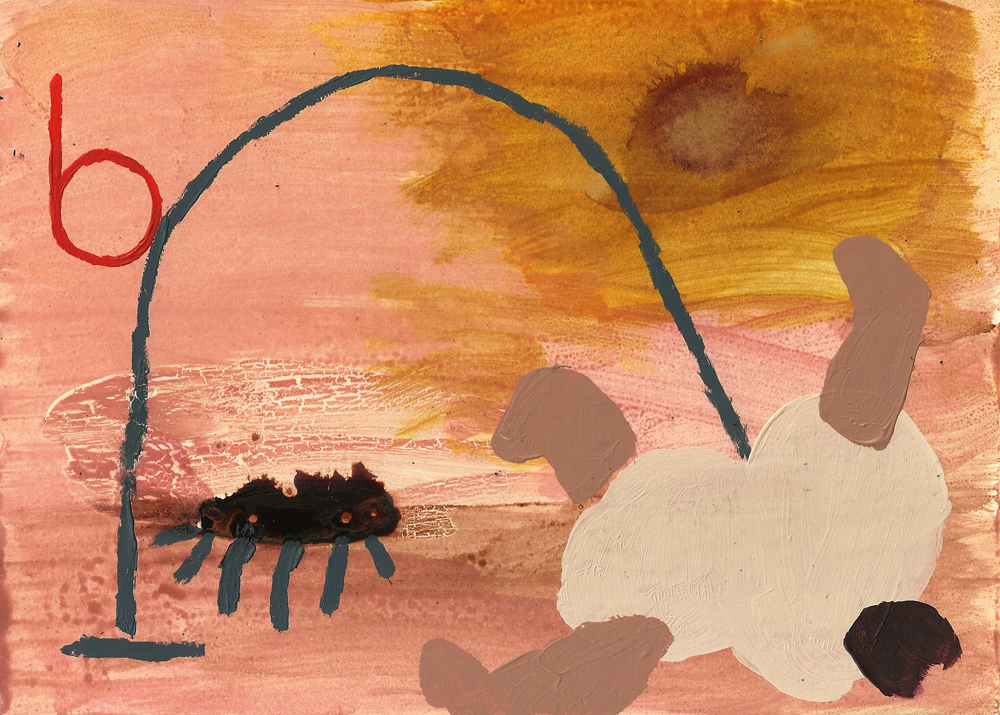
The painting signed Lonnie Holley that sits in mine
and my wife’s bedroom closet, is of a black snake twisting its way across
three-and-a-half feet of a red field. The snake’s body is like a road in
Atlanta. It is dark and twisting and goes nowhere. At one end a tail; at the
other a forked tongue. If this was an Atlanta road, somewhere along the dark
scales this road’s name would change and, while still the same road, it would
be a different road.
My father-in-law is not positive that the painting
he bought is actually by Lonnie Holley. The signature looks authentic, but the
work would be a departure from his typical “found object” forms. It is paper
and housepaint (I think). It looks a little more like something Mose Tolliver
might have painted.
Nellie May Rowe is probably my favorite outsider
artist. I particularly like her sculptures made from chewing gum. They are
these mounds out of which grows a head, with marbles for eyes, and fake hair
glued to the crown. They look like very fucked up voodoo dolls, maybe. Or maybe
like soon-to-be-homeless people staring vacantly nowhere hoping someone will
discover their genius. These feel completely human to me in a way that—say,
Rodin—cannot. They speak of real people and real lives and real pain and loss.
That sounds highfalutin. I just like them because they’re scary.
This painting by Lonnie Holley includes a humanoid
figure that seems to bow to the figure of the serpent. The rendering is a
child’s stick-figure drawing. The snake, I now realize, looks like some monster
out of Greek mythology—one of the severed heads of the hydra. Or no—it looks
like the basilisk in the Harry Potter movie, it’s head crowned, its fangs
protruding from the mouth like a boar’s tusks. The human figure is either
farther away from the viewer than the snake (i.e., perspective, a trait not
typically found in outsider art), or it is much smaller than the snake and
bowing to it in supplication or reverence. A dark man bowing to a dark serpent,
something Edenic.
According to Wikipedia there are 71 streets in
Atlanta that carry “Peachtree” in their name. And, as further evidence of
Atlanta city-planning as a kind of “outsider art” consider:
West
Peachtree Street is not a western branch of Peachtree Street, but a
major parallel (and unlike Peachtree, almost perfectly straight) due
north/south street running one block west of Peachtree Street through downtown,
and mostly two or three blocks west (due to the curves in Peachtree Street)
through Midtown. This was the original Peachtree Street, and it still divides
the northeast and northwest quadrants of the city and county for street
addressing purposes.
Where the current Peachtree Street turns to
Peachtree Road and briefly heads northwest, it actually crosses West Peachtree,
leaving it on the east side. It is at this point that the Spring-Buford
Connector (Georgia 13) begins, taking the route of old I-85. The studios of
WSB-TV are located on this section of "West" Peachtree Street, which
dead-ends at I-85. Through this section north of 17th Street in Midtown, and in
downtown south of North Avenue to Peachtree Street (and continuing south then
southwest on Peachtree to Luckie Street / Auburn Avenue), the MARTA north/northeast
line (red and orange/gold trains) runs directly under West Peachtree. Between
the two, it runs no more than a block to the east.
In asking if it’s okay that we store this painting
for him my father-in-law is also obsessive about worrying not to overstep boundaries,
or to burden us, which ironically is itself burdensome. He says, “If you can’t
hang onto it I understand. But it’s a really fantastic piece, and you should
display it if you think you’d like to look at it, because it is, it’s really
great. But I don’t want to make you hold onto it if you don’t think—” And here
is when I say, “It’s fine, it’s fine; it’s no big deal.”
In the cover photo on his Facebook page, Lonnie
Holley stands in front of one of his early sandstone carvings (for which he earned
the nickname The Sand Man). His eyes are wide, as if he’s agitated, or crazy,
or like someone just caught him masturbating.
There is some ongoing controversy in the outsider
art world concerning Bill Arnett, the Atlanta folk/outsider art collector,
dealer, and patron who took under his wing Lonnie Holley’s friend, the artist
Thornton Dial. The 2006 “nonfiction novel,” The
Last Folk Hero: A True Story of Race and Art, Power and Profit, demonizes
Arnett as a privileged white exploiter of the illiterate artist. But according
to others in the outsider art world, such as psychiatrist and art collector
James Sellman, who claims the 1993 60
Minutes segment on Arnett’s supposed exploitation of Dial, was fiction
perpetrated by others in the outsider art world who wished to suppress Arnett
so that they might corner more of the market.
The week that my in-laws came to town and my
father-in-law purchased this piece, they also went to the High Museum to see
“Hard Truths: The Art of Thornton Dial.” Turns out that night was “Culture Shock” and Lonnie Holley himself provided the music.
Also, turns out it was Lonnie Holley who introduced Dial to Arnett in
1987.
Of Atlanta’s north-south running city streets that
changes names around the Ponce de Leon boundary: Juniper Street becomes Courtland Street; Argonne Ave
becomes Central Park Place; Charles Allen Drive becomes Parkway Drive; Monroe
Drive becomes Boulevard; Briarcliff Road becomes Moreland Ave; Lullwater Road
becomes Fairview Road.

This map of Atlanta shows the geographic dispersion
of households by race. Red dots are Caucasian households; blue,
African-American. The yellow is Hispanic. That stark line of north-south
division runs roughly along the Ponce de Leon corridor.
My father-in-law worked his ass off for something
like forty years and became one of the officers and owners of his construction
company. He is in semi-retirement. But through most of my wife’s life, and most
of the time that I’ve known him, he’d be up at 4:30 or 5 in the morning, out
the door by 6, and at his office by 7 so that he could get a good two hours’
work in without anyone bugging him. He worked until 7 PM then came home, shared
a soup and half an English muffin with his wife. He took Saturdays off, and
worked from noon to 5, or thereabouts, on Sundays. “Workaholic” isn’t the right
word. The obsession with which he’s done his job carries over to his love of folk
and outsider art.
Molly writes:
the
background’s flaw is that it beckons . . .
Where
things trace back to one man’s wanting . . .
***
Jamie Iredell lives in Atlanta and teaches creative writing to college students. He is the author of The Book of Freaks, and Prose. Poems. a Novel. Fat, a collection of essays, is forthcoming in fall 2013, and The Lake, a novel, is forthcoming in 2014. His writing has appeared in many magazines, including The Rumpus, The Chattahoochee Review, The Literary Review, and PANK.
Jamie Iredell lives in Atlanta and teaches creative writing to college students. He is the author of The Book of Freaks, and Prose. Poems. a Novel. Fat, a collection of essays, is forthcoming in fall 2013, and The Lake, a novel, is forthcoming in 2014. His writing has appeared in many magazines, including The Rumpus, The Chattahoochee Review, The Literary Review, and PANK.